Why this crash owns the statistics
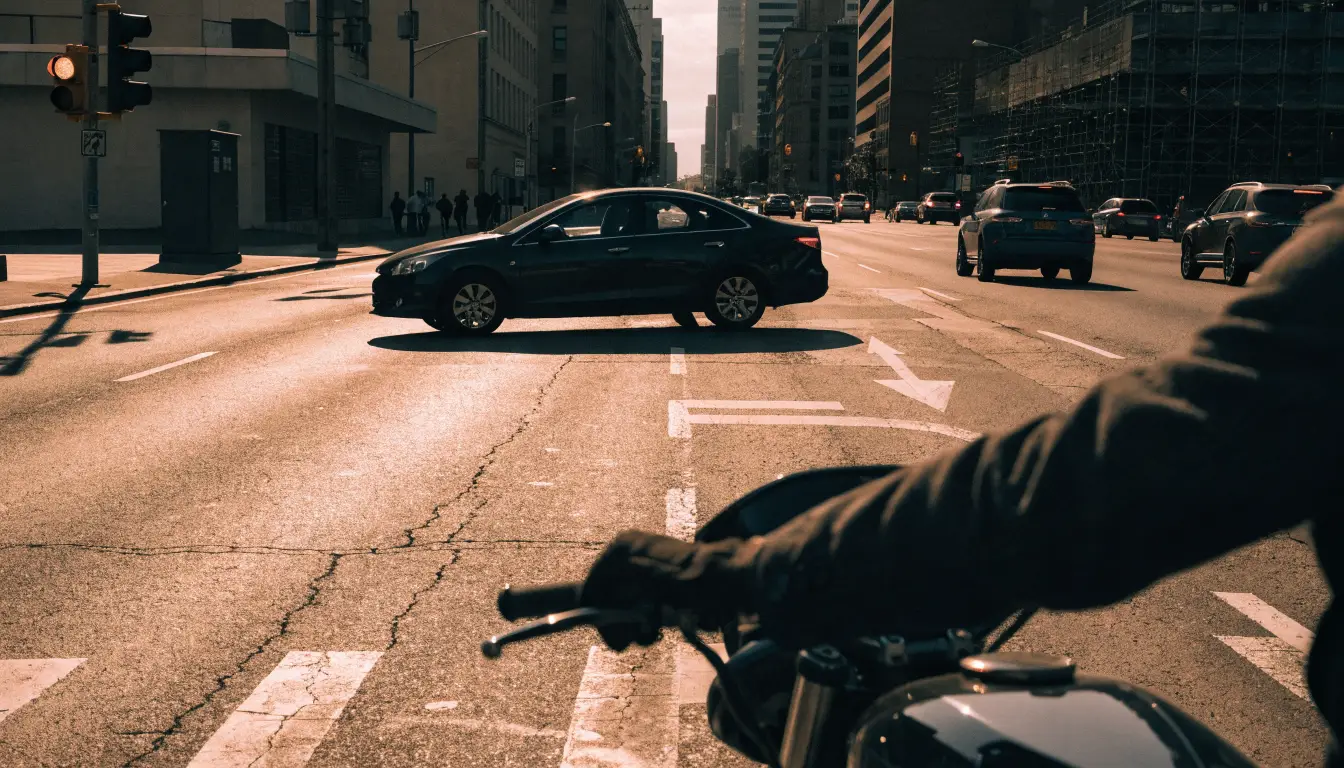
Riders present a narrow profile that drivers’ brains mis-time. Riverside’s geometry feeds it: Magnolia’s block-after-block left turns across arterial speed, University Avenue’s downtown–UCR mix, Arlington’s signalized crossings, the civic grid where court-day visitors hunt for a gap. The turner guesses at a space that is not there. The rider pays the physics.
This is not a claim that any particular intersection is “the most dangerous.” It is a description of how left turns and a narrow silhouette interact. The statute does the rest.
A protected left-turn arrow is the exception that swallows the excuse. A plain green is not protection. Section 21801 operates through every phase except a protected arrow.
The statute is the rider’s case
No motorcycle exception. No visibility proviso. When the defense argues speed, they are arguing a comparative percentage against a statutory yield duty — a discount fight, not a fault reversal. Bring evidence and the presumption holds.
A citation for failure to yield strongly advantages the file. It tracks the same duty. It wins the “who.” It does not automatically win the “how much.” Injury and speed arguments still get made. The citation just means those arguments start from behind.
Hi-viz gear and a headlight on gut the “couldn’t see” story. Photograph the gear as worn. Conspicuity evidence turns “invisible” into “didn’t look.”
Proving the three seconds
- Cameras — businesses on Magnolia and University Avenue watch these intersections. Footage settles gap-timing and cycles in days.
- The turning car’s own data — modern EDRs log speed and braking. Proving they never braked converts “sudden emergency” into inattention.
- Crush and throw — impact points and distances reconstruct closing speeds better than anyone’s estimate.
- Turn context — racing a stale yellow across oncoming traffic is a pattern jurors recognize.
Request the CHP collision report if the crash was on a freeway ramp. On city streets, get the Riverside Police report number before you leave. If the file later needs a complaint, it is often filed at the Hall of Justice — but the three seconds are proved by what you preserve this week.
How this crash looks on Magnolia, University Avenue, and the grid
Magnolia’s left turns happen at arterial speed. The turning driver is often trying to beat a light toward Arlington or the Galleria side. University Avenue adds students, staff, and people late to a downtown calendar. The civic grid adds visitors who do not know the couplet. None of that rewrites §21801. All of it explains why the gap was misjudged. Your file should explain the geometry in one diagram and then stop decorating.
Hypothetical: a rider in hi-viz on University Avenue is hit by a driver turning toward the UCR edge on a stale green. The driver says they never saw the bike. A shop camera two doors down has the three seconds. That camera is on a loop. Tuesday’s consult is late if the crash was last Thursday. Walk the corners before you argue on the phone.
Company vehicles and rideshare cars turning left are commercial-coverage files. Get the door logo, the app status if you noticed it, and the plate. Those details change the ceiling more than they change the yield duty.
Preserve the bike. Get treated. Decline the recorded statement. Then get the percentages read by someone who files rider cases in this county. (909) 233-7999.
Ask every nearby business for footage the same afternoon. A restaurant on Magnolia or a shop on University Avenue will not hold a Tuesday clip until your next day off. Helmet and bike photos belong in the same batch as the intersection photos — signal heads, skid, debris, the turning car’s rest position. That set reconstructs the three seconds better than a week-later walk-through.
If the turning driver was cited, get the citation number into your folder. If they were not, do not assume the statute disappeared. Section 21801 does not require a ticket to exist. It requires proof. Proof is the canvass and the physics.
Passengers in the turning car sometimes saw the bike and said so at the scene. Get their names. A passenger who “told him to wait” is a better witness than a week of adjectives. So is the rider behind you, if there was one. Numbers first. Stories later.
Do not guess your own speed on University Avenue or Magnolia to be polite. “I do not estimate speeds” is a complete sentence. Let scrape height, throw distance, and the turning car’s EDR do that work.
Then get treated the same day, even if you walked the bike off Magnolia.
After the crash
These cases pair serious injuries with relatively clean liability. That is why insurers need to discount them early. Decline the recorded statement. Keep the bike un-repaired until documented. Canvass the intersection within the week.
Get a rider-fluent read on the percentages before anyone assigns them for you. Splitting crashes are a different duty — see the lane-splitting rules. What the case may be worth, and how long it takes, is in the rider settlement timeline.
Free consult. (909) 233-7999.